A place to discuss works of art and architecture from pre-history to the present. Let the creativity and opinions flow...
Monday, November 23, 2009
Happy Thanksgiving
Norman Rockwell, Freedom From Want, 1943. War bond poster. Story illustration for The Saturday Evening Post, March 6, 1943. Oil on canvas, 45 3/4 x 35 1/2 in.
In the world of art Thanksgiving is exemplified by this painting Freedom From Want by Norman Rockwell. This image, also known as Thanksgiving Dinner, was the third in a series of four works from Rockwell's famous Four Freedoms series. The Four Freedoms were inspired by a speech given by FDR before congress where he spoke about the four basic freedoms to which every person was entitled. Rockwell's Four Freedoms were shown in The Saturday Evening Post in the same order as President Roosevelt presented them in his speech (freedom of speech, freedom to worship, freedom from want, and freedom from fear).
Freedom from Want is probably Rockwell's most recognized and beloved composition. As one of the covers from The Saturday Evening Post he spent quite a lot of time working on this piece. A major concern was to show the family not "in want" and yet at the same time not create an image of overabundance and selfish indulgence.
Rockwell was known for putting family and friends into images, which is this case here, as the "grandma" is actually a depiction of the Rockwell family cook, Mrs. Thaddeus Wheaton. We also feel as if we are a friend or family member at the table because of how the artist set up his composition. In the painting Rockwell extends the table beyond the borders of the canvas, beckoning us over to our seat at the end of the table by the sly glance of the gentleman in the lower right corner. Thus giving the perception that we are actually an invited guest at the table.
For me, this image includes a typical Midwestern spread and has all the components of this holiday. The table has the good china placed out for the occasion, all the carving tools are at the head of the table as Grandma proudly brings in her prized bird, children and grandchildren are happily conversing all around the table with their heads turning in every direction with huge smiles on their faces. It is a simple, humble, yet extremely joyful American tradition that Rockwell has given us here in his painting of Freedom From Want. This is the image of an American Thanksgiving that we have held in our heads and hearts for the last 65 years.
Wishing you and yours a bountiful and happy Thanksgiving, gobble-gobble!
May inspiration and creativity be with you!
Sunday, November 8, 2009
Fall of the Berlin Wall
This week on November 9th much of the world is celebrating the anniversary of the fall of the Berlin wall (1989). For me, when thinking about all the graffiti and other art on the Berlin Wall, the person that immediately comes into my mind, one of the most interesting, innovative, and politically active artists of the late 20th-century, is Keith Haring. In 1986 during a trip to Berlin, Mr. Haring painted a mural on a rainy day, after the skies cleared, and under the watchful eye of east German soldiers at the Brandenburg Gate. Keith Haring spoke in a language of symbols and signs that were universal enough to apply to anybody, anywhere in the world, free from limitations of language or even educational background. His messages, although often covering serious and grim topics, like the separation of Germany or Apartheid in South Africa, were always positive and rang of the unification of human beings rather than negativity or art merely for shock value.
Keith Haring's work was always focused on the line, which he created, without any preparatory work, at a staggeringly quick pace that would make most people stand rapt in awe and turn green with envy. His work was simple but not simplistic, a skill that is not easy to achieve. He made works which spoke to us in a humanistic way and that encouraged us to better the world with utmost sincerity. He felt art and artists were responsible for pushing forth ideas and using their talents to bring awareness to the masses and often to help those who needed the world's attention the most.
An excellent but short documentary on Keith Haring is "Drawing the Line: a Portrait of Keith Haring" if you are interested in finding out more about this amazing artist who was gone far too soon.
May inspiration and creativity be with you!
Tuesday, October 27, 2009
Bewitched
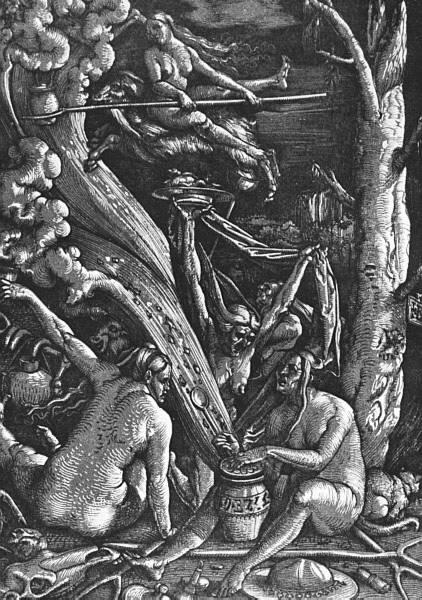
With Halloween week here I wanted to present an image that speaks of spookiness and things that go bump in the night, in the world of fine art of course. For me, one of the first images that comes to mind is this woodblock print by Hans Baldung Grien from 1510 called Witches' Sabbath.
The image is of three naked and grotesque women gathered around a cauldron in a gloomy and nocturnal setting, with pitchforks being used as brooms and shovels scattered about the work. It has a bizarre and cryptic message on the vase in between the legs of one of the coven's members, as their concoction explodes and spews forth unidentified objects, fumes, and liquids. Another hag, with her arms outstretched, holds a platter with dead poultry, possibly making an offering to the devil, as a fourth witch zooms by riding backwards on top of a goat. These women are definitely a perversion of the natural order of things, celebrating with wicked abandon their sheer glee and rapture as they perform their evil rituals.
If you have not had the opportunity to explore the works of this artist I highly recommend you do some searching and check it out. Hans Baldung Grien took printmaking to a whole new level during the first half of the 16th-century. He incorporated unusual themes, such as witchcraft, into his work, making his imaginative prints and paintings an interesting record of life in 16th-century Germany.
Have a safe, spooktacular, and Happy Halloween everybody!
May inspiration and creativity be with you!
Labels:
Germany,
Halloween,
Hans Baldung Grien,
Prints,
Witches
Thursday, October 15, 2009
Controversial New Sculpture
Entropa by David Cerny, January 2009, outside the European Union in Brussels.
As I was catching up on some reading on the latest controversial works by artists, I came across this odd piece by artist David Cerny titled Entropa. The sculpture was created for and installed outside the entryway to the European Union in Brussels. The work was supposed to have been a collaboration between 27 artists and a somewhat patriotic and non-controversial work to celebrate the Czech Republic's presidency of the council of the European Union.
It is customary for the presiding country to place an exhibit in the Justus building to mark their presidency of the EU, and it is usually rather uncontroversial, such as when France, the previous holder of the presidency, erected a large balloon clad in the nation's colors of red, white and blue. Instead of an ordinary patriotic message or a collaboration among 27 people as it was supposed to happen, David Cerny and three assistants got together, faked artist profiles and descriptions of their supposed contributions, and created this satirical and controversial work depicting stereotypes of EU nations.
The other pickle in the works here is that the sculpture was ordered to be taken down; but, not by any of the nations depicted in vulgar and inflammatory ways. The artist, David Cerny, demanded his work be moved as a protest against political upheaval in his own country. It amazes me honestly, that none of the people visiting the building or those working within it seemed upset by the blatant mocking of their nations outside the building where so many politicians scurry off to discuss important maters of state relations. The little devil on my shoulder also wonders what Mr. Cerny would have done had he tackled the idea of making a piece for the U.S. in such a satirical and mischievous manner....??
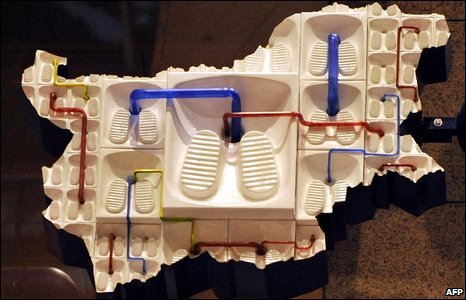
Pictured below are details of four of the countries on the piece:
Bulgaria - represented as a Turkish toilet
France - represented by its near constant striking
Labels:
Brussels,
Controversy,
Entropa,
European Union,
Sculpture
Wednesday, September 23, 2009
Autumn in all its Glory
Claude Monet, Autumn at Argenteuil, 1873, oil on canvas, 21.5 inches x 23.9 inches.
Fall or autumn is simply my favorite season of the year. I love the fresh crisp air, the smell of cinnamon, the gorgeous colors of the leaves as they change, and of course the taste of delicious fresh apples, be it pie, cider, or just a good apple in the hand. As a tribute to this wonderful season, today's work is Autumn at Argenteuil by Claude Monet. As many of you probably already know, Monet was an Impressionist, perhaps THE Impressionist, as he is credited with founding the movement, and one of the only Impressionists who stuck to that style for most of his life.
Autumn at Argenteuil has buildings in the distance, water ( it is the Seine), and prominently features autumn foliage. He delicately captured the feel of the season and provided the viewer with an homage to texture. The surface of this painting has been worked and reworked many times to weave together both the textures and colors of the season, as the objects in the work dissolve into colorful light. Here we have a prime example of the Impressionist palette that covers the full rainbow of colors.
The interesting vantage point of this painting was created by Monet in his "floating studio." Monet had a small boat outfitted with a hut to house his painting materials, and if need be to sleep in, with just enough room for a tiny desk upon which he set his easel. I find it interesting to take a moment and picture Monet floating around the Seine on his buoyant studio, trying diligently to capture a perfect autumnal moment.
This little "floating studio" allowed Monet to capture a variety of viewpoints in his paintings, many more options than he could from just the shore. That is what allowed him to do full justice to this breathtaking scene of the Seine in full autumn glory. In this work we can see the foreground, a long perspective of water, and the delicate play of light as it gleams on the surface of the river with colorful reflections abounding.
May inspiration and creativity be with you!
Labels:
Argenteuil,
autumn,
Claude Monet,
fall,
Impressionism,
Seine
Wednesday, September 9, 2009
War is Hell (*Graphic Images*)
Title: The Harvest of Death, Gettysburg Pennsylvania, July 1863. Artist: Timothy O'Sullivan.
Photo: Julie Jacobson. From the article "The Death of One Marine in Afghanistan." Photo is from Aug. 2009 article is from Sept. 2009.
Yesterday while commuting to and from work I was listening to NPR, as is my usual practice. I find it very stress relieving while driving in crazy traffic that is sprinkled by a lack of turn signals and a pinch of construction. All the talk for the majority of the day seemed focused on a rather controversial photo taken by the AP (Associated Press), a news organization that has been reporting for one-hundred and sixty-three years. This story really made me think, where do we draw the line?
In the art history and art appreciation texts I have read and that I teach from there are lots of examples of gruesome and controversial art. There are a plethora of examples where artists respond to the tragedies of war as well, but, nobody seems all in a tussle about these images anymore. Is it time that takes away the sting? I personally find the images of the dead soldiers from the Civil War just as disturbing as the ones from the war in Afghanistan, but yet one is so much more controversial than the other. They both fall into the category of documentary photography, they are both dead young men, and they both stirred discussion in their times. So, where is it exactly that we draw the line between acceptable documentary photography that captures war and something that is just too much? I don't think anybody has the right answer or if there even could be an answer that is considered "correct" but, I think it is important that we think about where the lines are drawn in situations like these to open a discourse about art, the events in our lives, and the recording of history as it is being made.
Links to the article, photograph, and discussion of the controversy can be found here: http://www.eandppub.com/2009/09/ap-photo-of-afghan-death-that-is-causing-controversy.html
May inspiration and creativity be with you!
Labels:
Afghanistan,
Controversy,
Documentary,
photography,
Soldier,
War
Friday, August 28, 2009
Laughing Is Allowed
Title: The Descent of the Ganges. Location: Mamallapuram, India. Date: 7th C. Medium: Granite. Size: height approx. 30'
I often think that one of the reasons people "don't like" art is because they are afraid they must always be serious around it. For a person who has not studied the visual arts in-depth, they can often seem confusing, elitist, and humorless. O contraire mes amis!! One of my favorite pieces of art is The Descent of the Ganges pictured above. This work shows that even in serious religious art (it is a Hindu piece) there can be hidden gems and a wonderful sense of humor.
Below are two closeup images of the work that demonstrate this for the viewer. In the carving, there is a gorge going straight down through the middle which, is in place for water to come flowing down and fill up the pool below. Directly to the left of this "waterfall" we see an ascetic: he has spent much time in a difficult meditative pose, not allowing himself food or water, to show his serious religious devotion to Shiva. As a reward for such staunch efforts, Shiva is granting him a "boon," or what is his heart's desire.
If we trace our eyes diagonally down from this scene across the "waterfall" we see what at first appears to be another ascetic showing his deep devotion. Upon further investigation it becomes clear that this is no man but a cat who is surrounded by mice at his hind paws. This cat has cleverly imitated the holy and righteous actions of the ascetic in order to trick the mice into thinking he is benevolent and would not harm them. O contraire my little rodent friends, he is indeed going to eat you for dinner!
So the lesson for today is twofold: never judge a book (or cat) by it's cover, and do not assume art doesn't have a sense of humor.

May inspiration and creativity be with you!
Labels:
Descent of the Ganges,
Hindu Art,
humor,
iconography,
Indian Art,
Sculpture
Subscribe to:
Posts (Atom)
Blog Awards
Some awards this blog has received thanks to some nice folks!
One Lovely Blog Award
given on 07/24/2009 by Nanny Dee (http://newenglandnanny.blogspot.com/)


